> ## Documentation Index
> Fetch the complete documentation index at: https://c42d5cb-opencomputer.manicule.dev/llms.txt
> Use this file to discover all available pages before exploring further.
> For every page in one file, fetch https://c42d5cb-opencomputer.manicule.dev/llms-full.txt (large).
> To search and read these docs as tools, connect the MCP server at https://c42d5cb-opencomputer.manicule.dev/api/mcp.
> Every agent surface: https://c42d5cb-opencomputer.manicule.dev/.well-known/llms-manifest.json
# Shared threads (/slack/shared-threads)
Related: [Threads](/slack/threads.md), [Linked and spawned threads](/slack/linked-and-spawned-threads.md), [Mid-turn messages](/slack/mid-turn-messages.md), [Permission modes](/slack/permission-modes.md), [Approvals, questions and plans](/slack/approvals-questions-plans.md), [Subagents](/slack/subagents.md)
> Anyone on the people list can steer a session with its owner's secrets; replies not meant for the bot get no answer
 ## Owner
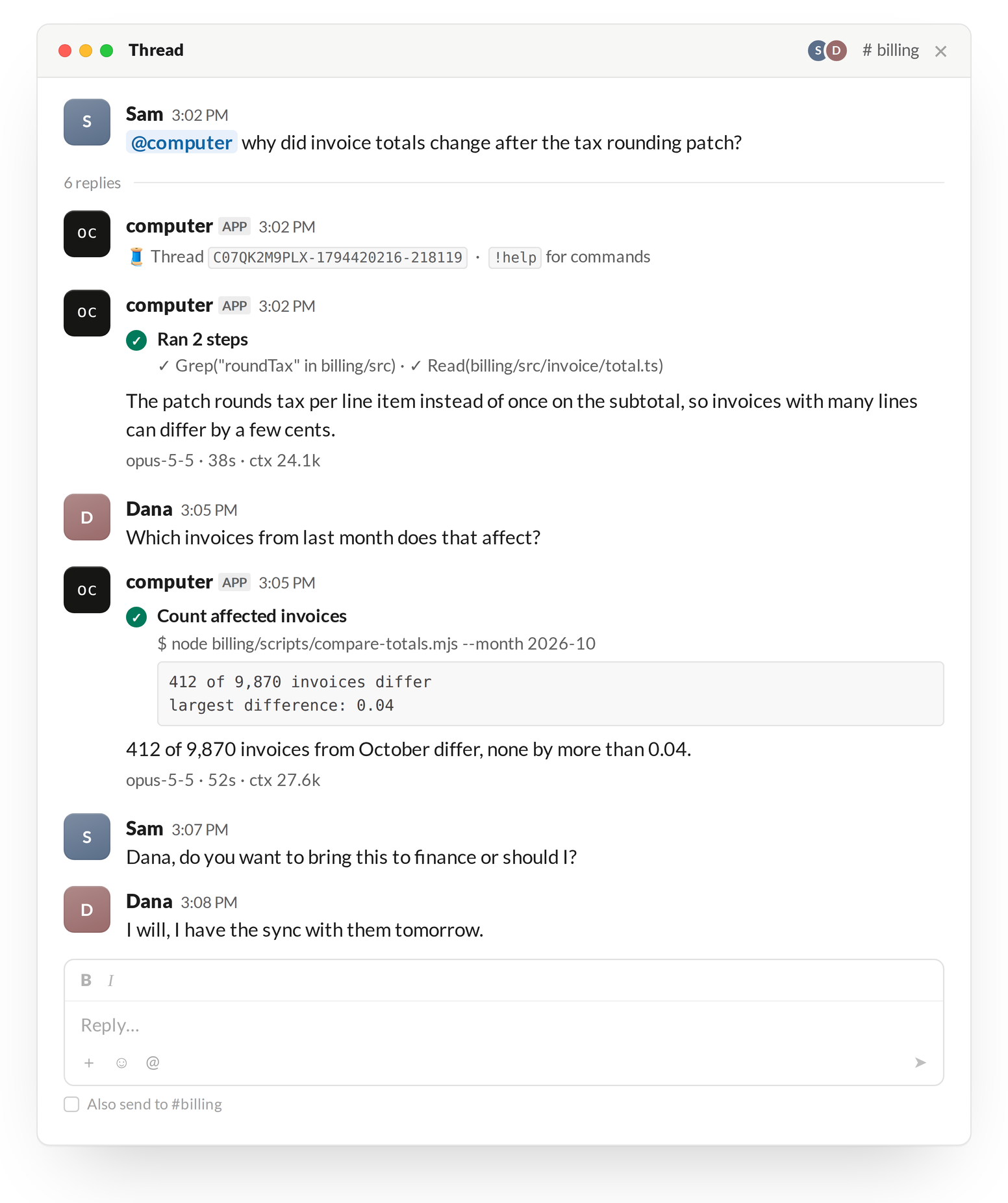
The person whose message started the session owns it. A session started by `spawn_thread` has its parent's owner.
In a team install the session:
* runs in the owner's workspace;
* gets the owner's secrets and variables, plus the session's own and the workspace-wide ones (see [Secrets and variables](/slack/secrets-and-variables));
* reads and posts to other threads with the owner's Slack access (see [Linked and spawned threads](/slack/linked-and-spawned-threads)).
## Who can steer
| Person | Message that mentions `@computer` | Reply without a mention | Buttons on approvals, questions, plans |
| --------------------------------------------- | -------------------------------------------------------- | ----------------------- | -------------------------------------- |
| On the [people list](/self-hosting/configure) | Delivered | Delivered | Accepted |
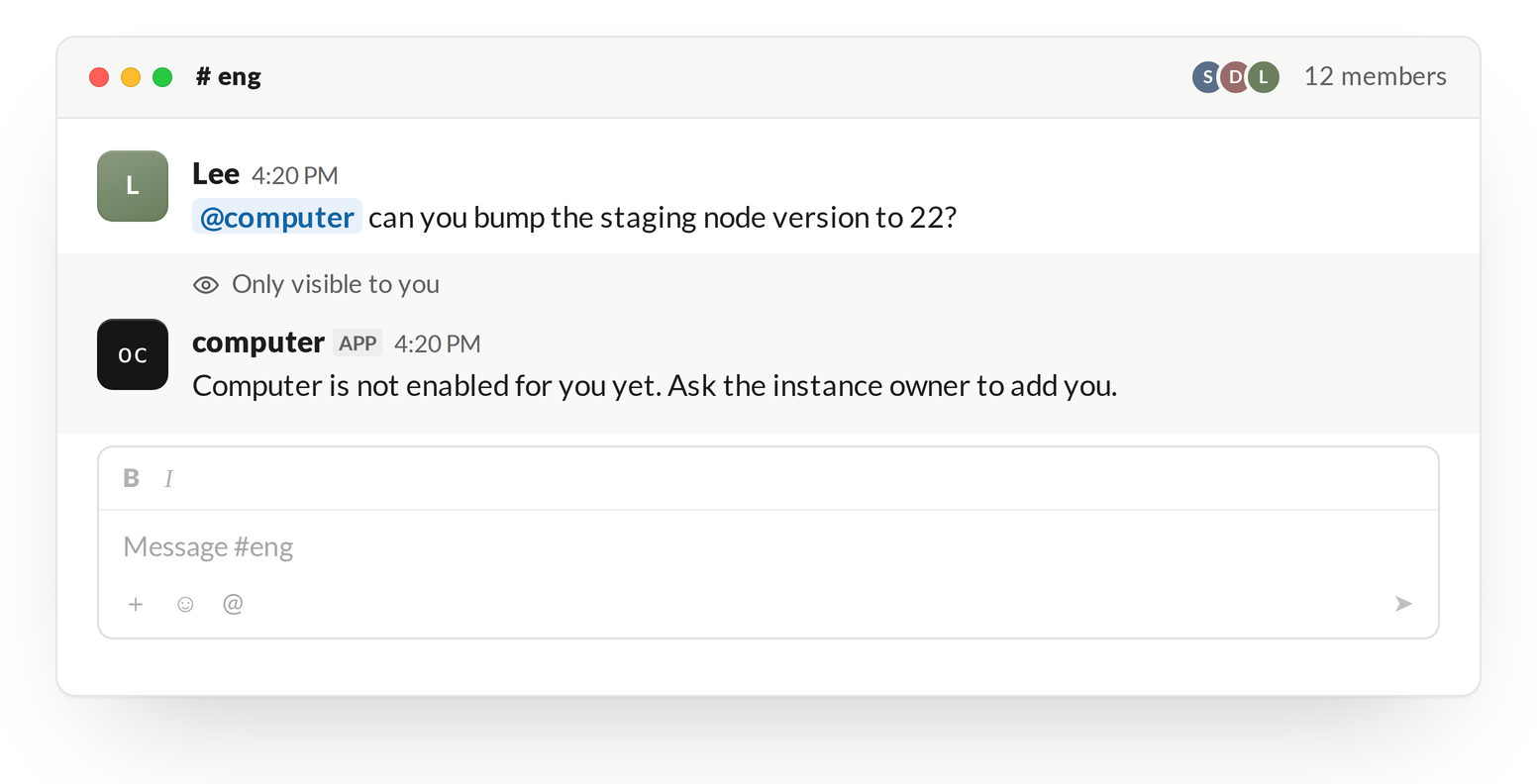
| Not on the people list | Not delivered; ephemeral "not enabled for you yet" reply | Dropped silently | Refused with the same ephemeral reply |
Anyone whose messages are delivered can send instructions, run `!` commands (including `!stop` and `!mode`) and answer prompts. They act with the owner's workspace and secrets.
One-machine mode has no people list: every reply in a session thread is delivered.
 Not in the open-source code yet (runner isolation). Until it lands, every session on a computer runs as one Unix user, so a session can read other sessions' files and secrets on the same computer.
## When the bot stays silent
The model decides whether each delivered reply is for it. If not, nothing is posted: no message, no card, no footer.
* The model can misjudge either way.
* A silent turn still runs the model and counts towards usage.
* In a direct message, every message counts as addressed to `@computer`.