> ## Documentation Index
> Fetch the complete documentation index at: https://c42d5cb-opencomputer.manicule.dev/llms.txt
> Use this file to discover all available pages before exploring further.
> For every page in one file, fetch https://c42d5cb-opencomputer.manicule.dev/llms-full.txt (large).
> To search and read these docs as tools, connect the MCP server at https://c42d5cb-opencomputer.manicule.dev/api/mcp.
> Every agent surface: https://c42d5cb-opencomputer.manicule.dev/.well-known/llms-manifest.json
# Threads (/slack/threads)
Related: [Shared threads](/slack/shared-threads.md), [Linked and spawned threads](/slack/linked-and-spawned-threads.md), [Mid-turn messages](/slack/mid-turn-messages.md), [Permission modes](/slack/permission-modes.md), [Approvals, questions and plans](/slack/approvals-questions-plans.md), [Subagents](/slack/subagents.md)
> Each Slack thread is one session; its runner exits after 2 hours idle and resumes on the next message
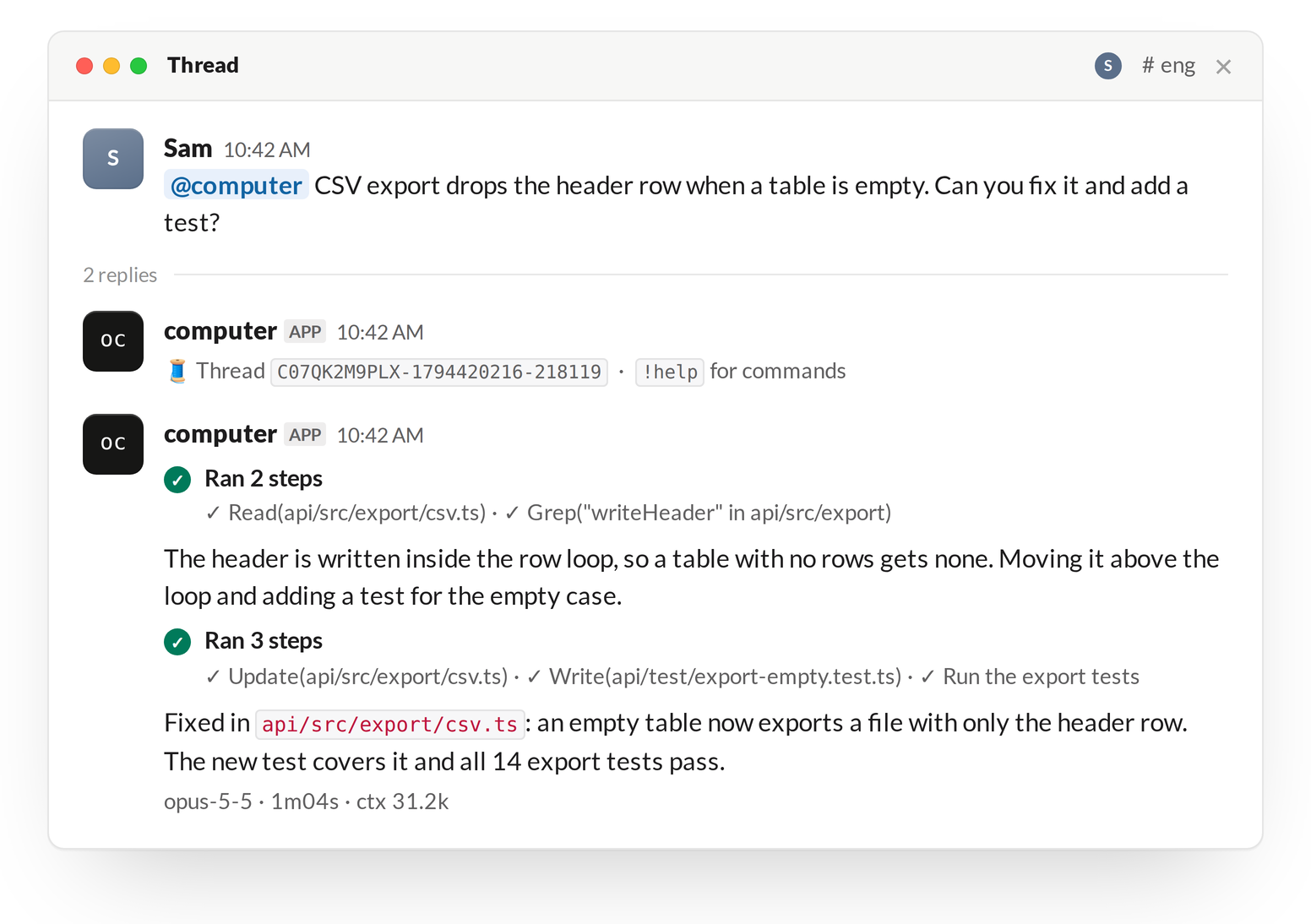 ## Starting a session
| Where | What starts a session | Later messages |
| --------------- | ---------------------------------------------------------------------------------- | ---------------------------------------------------------------------------------------------------------------- |
| Channel | A message that mentions `@computer`. Its thread is the session. | Every reply is delivered; the agent answers the ones meant for it (see [Shared threads](/slack/shared-threads)). |
| Existing thread | A reply that mentions `@computer`. The session also receives the replies above it. | Same. |
| Direct message | Any message. No mention needed. | Every message in that DM thread is for the agent. |
Only people on the [people list](/self-hosting/configure) get a session; anyone else gets an ephemeral "not enabled for you yet" reply. One-machine mode has no people list: anyone who can reach `@computer` can start a session.
Edited messages and messages from bots are ignored.
## Turn output
1. **Status.** Slack shows "is thinking…" on the thread, or an :eyes: reaction if the status call fails.
2. **Step cards.** Each tool call is a step with its arguments and an output tail. Consecutive steps share one card, which ends as "Ran N steps" with a count of failures.
3. **Text.** The agent's text streams into the same message between the cards.
4. **Footer.** Model, reasoning effort (once set with `!effort`), permission mode (when not `bypassPermissions`), duration and context size. A stopped turn's footer starts with the reason. Cost is in `!status`.
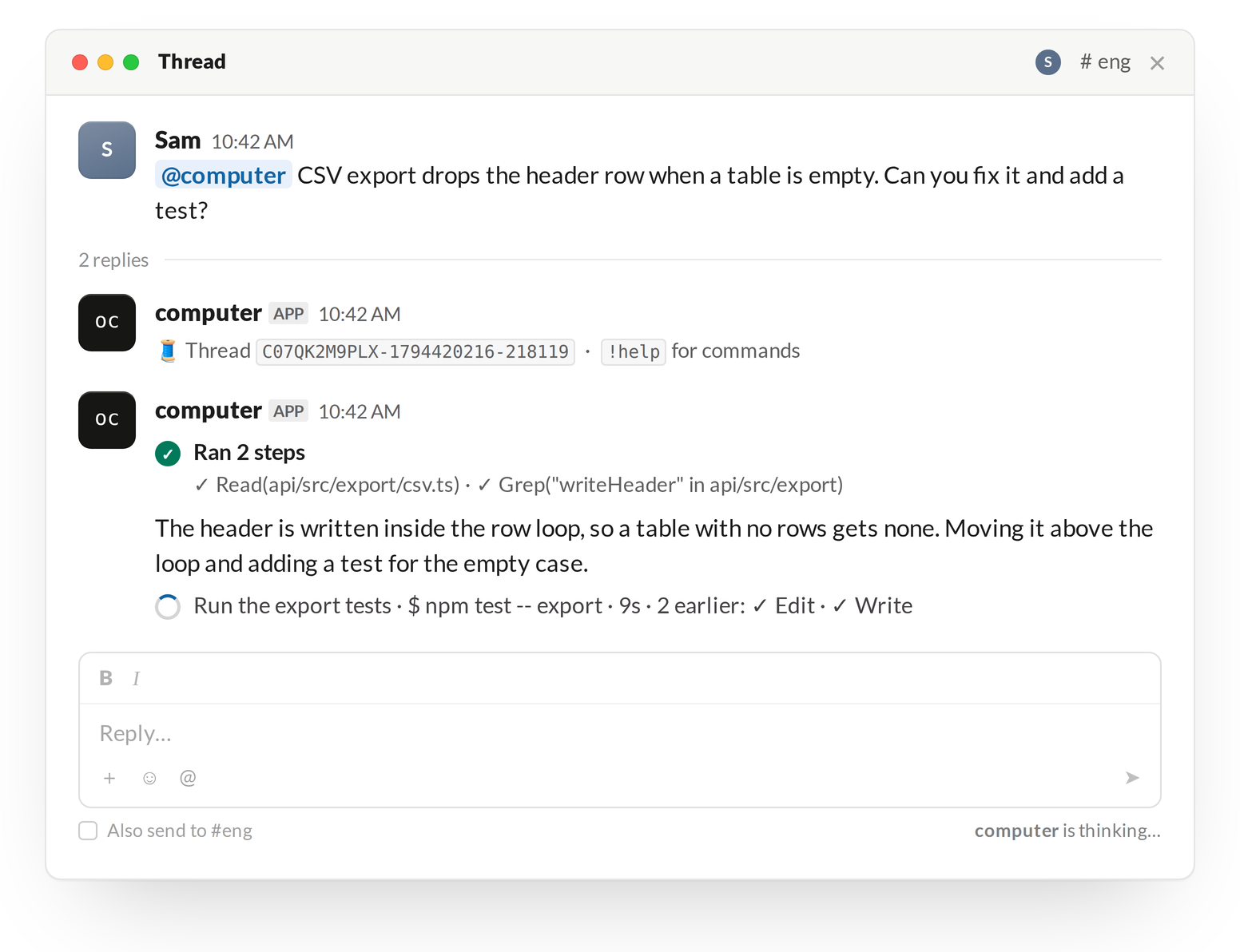 A long reply continues in a new message: Slack closes a stream after about 10 minutes and caps a message's length. A turn waiting on an answer does not open a new message, so it sends one notification.
| What you see | Cause |
| ------------------------------------------------------------------------------- | ----------------------------------------------------------------------------------- |
| ":warning: agent process ended: …" | The harness process died. The next message starts it again. |
| ":warning: couldn't reach the session: …" | The gateway could not deliver the message to the runner. |
| "The agent host is offline; your message will be delivered when it reconnects." | The host is not connected to the gateway. The message is queued for up to 24 hours. |
## Commands
A message that starts with `!` is a command to the session, not a message to the agent: `!status`, `!stop`, `!diff`, `!restart`. See Slack commands.
## Idle exit
The host stops a session's runner 2 hours after the last message (`SP_IDLE_MS`). It waits while a turn is running or waiting on an answer, a subagent is running, or an API terminal is open.
The next message starts a new runner that resumes the same conversation in the same directory; the first reply is slower. See Session durability.
One-machine mode has no idle exit.